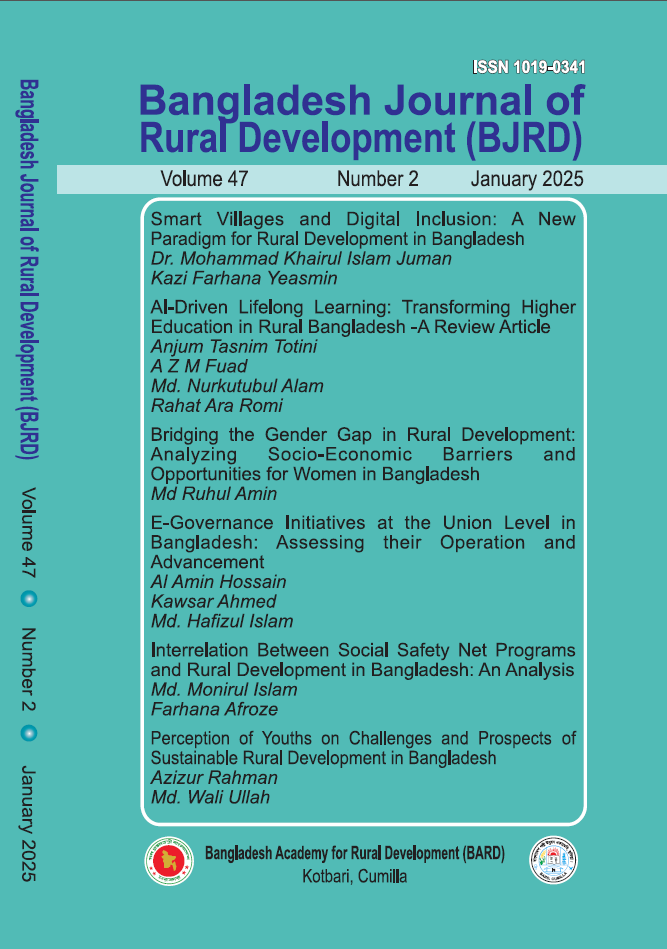
Smart Villages and Digital Inclusion: A New Paradigm for Rural Development in Bangladesh
Keywords:
Smart village, Rural Development, digital literacy, e-governance, digital inclusionAbstract
This research examines how digital inclusion contributes to sustainable rural development in Bangladesh, focusing on the implementation of smart village strategies. The study investigates four core variables smart infrastructure, e-governance-services, access to ICT tools, and digital literacy to determine their collective and individual impact on rural transformation. Based on data collected from rural populations and analyzed through correlation and regression techniques, the findings reveal that each factor has a statistically significant positive influence on development outcomes. Notably, smart infrastructure and digital literacy emerged as the most impactful elements, highlighting the need for both physical access and human capability. Additionally, digital literacy plays a mediating role in enhancing the effectiveness of ICT-based interventions. The study contributes to policy and academic discourse by offering an integrated framework that aligns with the “Digital Bangladesh” vision and supports broader goals of inclusive and technology-driven rural progress.
Downloads
References
A2i. (2022). Smart village and digital Bangladesh vision. Aspire to Innovate Programme, ICT Division, Government of Bangladesh.
Ali, M., & Akter, S. (2020). Impact of ICT training on economic empowerment in rural Bangladesh. Journal of Rural Development Studies, 12(1), 55–68.
Bangladesh Telecommunication Regulatory Commission (BTRC). (2023). Annual report on rural connectivity and digital access. https://www.btrc.gov.bd
BIGD. (2021). Digital skills landscape in rural Bangladesh. BRAC Institute of Governance and Development. BRAC, Dhaka.
Chatterjee, A., Banerjee, T., & Pramanik, S. (2020). Smart villages: A localized approach to digital transformation. Development Informatics Review, 9(2), 25–41.
Chowdhury, R., & Alam, K. (2024). Rethinking rural empowerment through smart village models. South Asian Development Studies Journal, 18(1), 67–84.
European Network for Rural Development. (2017). Smart villages: Revitalizing rural services. https://enrd.ec.europa.eu
European Network for Rural Development. (2022). Smart villages: Revitalizing rural services through digital and social innovation. https://enrd.ec.europa.eu
Ghosh, T. (2021). Digital divide and e-governance challenges in Bangladesh. ICT and Society, 6(2), 18–32.
Government of Bangladesh. (2021). Union Digital Centers: Expanding digital services at the grassroots. Cabinet Division & A2i.
Haque, A., & Kabir, R. (2022). Digital connectivity in rural Bangladesh during COVID-19. Journal of Development and Technology, 10(3), 120–136.
Haque, A., & Kabir, R. (2023). Smart village implementation in rural Bangladesh: Governance and infrastructure challenges. Bangladesh Journal of Public Administration, 28(2), 33–49.
Hasan, M. A., & Mostafa, N. (2025). Digital skills gap among rural populations: Evidence from Bangladesh. Asian Journal of ICT and Development, 5(1), 15–29.
Islam, M. T., & Zaman, S. (2021). E-inclusion and rural transformation in Bangladesh. Information Society & Development, 7(1), 45–60.
Islam, S., Rahmat, R., & Nazrul, A. (2025). Evaluating the performance of Union Digital Centers: A user-based study. International Journal of Rural ICT, 3(2), 88–104.
Khatun, F., & Hossain, M. (2023). Digital governance in rural local government bodies. Policy and Technology Journal, 14(1), 22–40.
Kumar, S., & Singh, A. (2019). Smart villages in South Asia: Lessons from India and beyond. Rural Development Perspectives, 11(4), 76–91.
Mazloum Yar, M., & Naderi, S. (2025). Human-centered ICT development in low-literacy regions: A case study. Global Journal of Inclusive Technologies, 4(2), 35–50.
Nasir, R., Sultana, A., & Chowdhury, M. (2024). Inclusive digital design for rural communities: Challenges and opportunities. Technology and Society, 9(1), 101–118.
Rahman, A., & Hossain, M. (2020). Digital transformation and rural inequality in Bangladesh. Bangladesh Journal of Development Research, 17(3), 55–72.
Rahman, M., & Sultana, R. (2023). Trust, awareness, and the effectiveness of UDCs in rural Bangladesh. Journal of E-Governance and Innovation, 8(2), 73–89.
Rahman, T., Islam, F., & Ahmed, J. (2023). Youth digital entrepreneurship in rural Bangladesh. Asian Journal of Innovation and Development, 6(1), 29–47.
Rahmat, R., & Nazrul, A. (2025). Service delivery evaluation of rural digital centers in Bangladesh. Digital Governance Review, 12(1), 39–55.
Shafi, S., & Yasin, T. (2023). Mobile penetration and digital literacy: The rural Bangladesh paradox. Digital Equity Studies, 2(1), 12–26.
UNDP. (2022). Smart village frameworks for inclusive development. United Nations Development Programme. https://www.undp.org
UNDP. (2023). Digital inclusion and human development in South Asia. United Nations Development Programme.https://www.undp.org
UNESCO. (2023). Digital literacy and sustainable development: Global priorities for 2030. https://unesco.org/reports/digital-literacy
World Bank. (2022). Bangladesh: Accelerating digital transformation for inclusive growth. https://www.worldbank.org
World Bank. (2023). Digital development report: Advancing rural connectivity. https://www. worldbank.org
Ahmed, T., & Karim, M. (2023). Governance mechanisms for sustainable rural development. Public Policy and Rural Economy, 6(2), 77–93.
Ahmed, T., & Yasmin, N. (2022). The second-level digital divide: Challenges of usage in rural Bangladesh. Journal of Technology and Development, 13(3), 61–77.
Akter, F., & Rahman, M. (2021). Barriers to ICT-based learning in rural communities: Evidence from Bangladesh. South Asian Education and Technology Journal, 6(1), 55–70.
Alam, F., & Rumi, S. (2024). Impact of community-based digital training: Evidence from Union Digital Centers. Bangladesh Journal of ICT and Society, 8(1), 12–28.
Alam, M., & Chowdhury, R. (2023). Ecological sustainability and rural livelihoods in South Asia. Environmental Development Review, 10(2), 21–39.
Alam, T., & Chowdhury, S. (2024). Union Digital Centers and grassroots ICT training: An evaluation. Rural Innovation Quarterly, 9(3), 22–39.
Alam, T., & Chowdhury, S. (2024). Strengthening rural governance through digital innovation: Evidence from Union Parishads. South Asian Governance Journal, 8(2), 21–40.
Begum, N., & Alam, R. (2025). Localizing ICT training: Designing culturally appropriate skill programs for rural populations. Community Technology Review, 8(1), 41–59.
Begum, R., & Nasrin, S. (2025). Women’s empowerment and sustainable rural development: A case study from northern Bangladesh. Gender and Rural Studies, 9(1), 58–76.
Begum, R., & Rahman, H. (2025). Promoting responsible digital citizenship in underserved communities. Journal of Rural Media Literacy, 10(1), 19–36.
Chowdhury, A., & Sultana, R. (2021). Bridging the digital divide: Empowering rural communities through literacy. South Asia ICT Studies, 9(1), 33–49.
Haque, S., & Alam, K. (2022). Climate resilience in rural development planning. Bangladesh Journal of Environmental Policy, 11(1), 15–29.
Haque, S., & Nasrin, R. (2022). Digital skills and women's economic empowerment in rural South Asia. Gender and ICT Review, 7(1), 33–51.
Hossain, M. A., & Akter, N. (2022). Gender and digital inequality in rural South Asia. Journal of Development and Technology, 7(2), 27–44.
Islam, M., & Akter, S. (2021). Pandemic and the push for e-governance in rural Bangladesh. Digital Policy Insights, 4(4), 88–101.
Islam, M., & Haque, R. (2021). Enhancing e-governance through digital literacy: Lessons from grassroots Bangladesh. Journal of Public Innovation, 4(2), 44–59.
Islam, N., & Mahmud, A. (2024). Digital inclusion as a pillar of rural sustainability. Journal of ICT and Development, 7(1), 17–34.
Islam, M., & Rahman, T. (2022). From digital literacy to livelihood: A pathway for sustainable ICT education in villages. ICT & Development Journal, 10(2), 73–89.
Kabir, A., & Sultana, H. (2023). Service delivery disruptions in e-governance: Rural connectivity challenges in Bangladesh. Journal of Digital Governance, 10(3), 77–91.
Kabir, L., & Hasan, S. (2023). Digital cooperation and rural economic networks: A case study from Bangladesh. ICT for Inclusion Review, 6(3), 73–91.
Khatun, L., & Hossain, A. (2023). Rural freelancing and resilience during COVID-19: A case from Bangladesh. Digital Work and Society, 11(2), 14–31.
Khatun, S., & Hossain, T. (2022). Community-led sustainability: Evidence from rural Bangladesh. Participatory Development Studies, 5(3), 33–51.
Rahman, H., & Karim, R. (2023). Evaluating the effectiveness of e-governance in rural Bangladesh: Lessons from UDC operations. Journal of Rural Public Administration, 12(2), 33–49.
Rahman, H., & Mostafa, T. (2023). Understanding digital literacy in rural Bangladesh: From access to application. Journal of Rural Digital Development, 11(2), 55–72.
Rahman, M., & Sultana, H. (2023). ICT skills for empowerment: Evaluating rural digital training programs in Bangladesh. Journal of Development Studies, 15(2), 45–63.
Sultana, R., & Ahmed, S. (2024). Infrastructure gaps and digital exclusion in rural Bangladesh: Challenges to digital equity. Information and Society, 11(2), 91–110.
Downloads
Published
Issue
Section
License
Copyright (c) 2025 Dr. Mohammad Khairul Islam Juman, Kazi Farhana Yeasmin (Author)

This work is licensed under a Creative Commons Attribution-NonCommercial-NoDerivatives 4.0 International License.