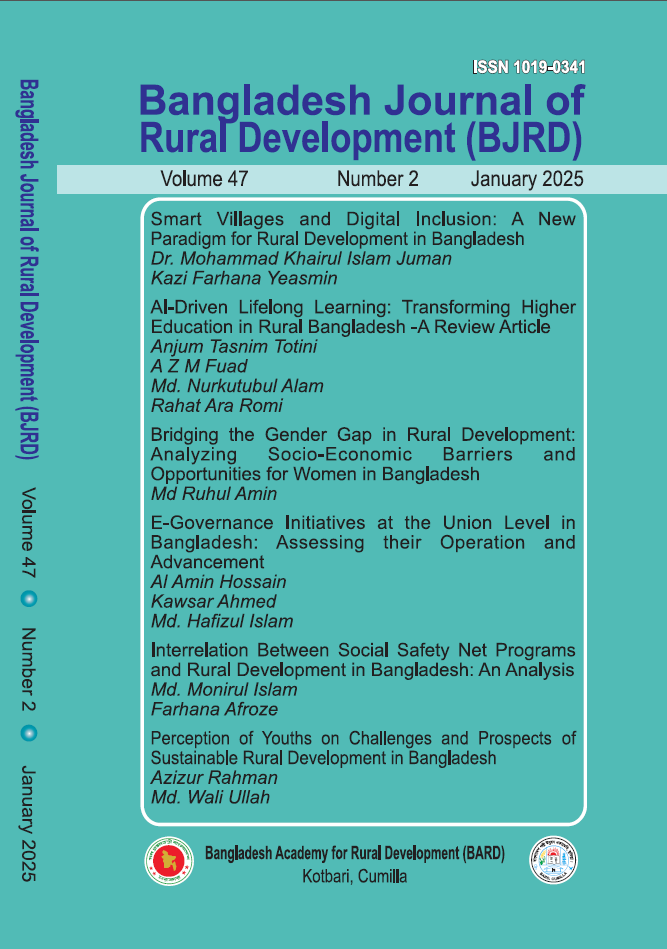
E-Governance Initiatives at the Union Level in Bangladesh: Assessing their Operation and Advancement
Keywords:
e-governance, service delivery, digital literacy, union level governanceAbstract
E-Governance initiatives promise to transform governance and enhance service delivery at the union level in Bangladesh. This study examines the effectiveness and challenges of implementing these initiatives in Kushtia Sadar Upazila, focusing on service recipients and providers. A mixed-method approach including surveys and interviews was used with 200 service recipients and 100 service providers. The study found that 80% of service recipients and 85.5% of service providers were male, indicating gender imbalances. Additionally, 83% of service recipients had digital literacy skills, but only 16.58% gained these skills through formal education, often citing inadequate materials and unskilled trainers. Key challenges included infrastructural constraints, bureaucratic hurdles and a lack of awareness among service recipients. Server downtime and poor internet connectivity were the major findings where 74% were exposed to poor internet connectivity and 48% had significant disruption of server problem. Despite these obstacles, 79.5% of service recipients expressed optimism about e-governance reducing corruption and improving governance practices. Recommendations stemming from the findings include infrastructural investments, capacity-building programs and enhanced citizen engagement initiatives. The study underscores the transformative potential of e-governance initiatives at the union level and highlights the need for concerted efforts to address implementation challenges and maximize benefits for citizens.
Downloads
References
Ahmad, T. (2021). E-Government in Bangladesh: Development and Present State. International Journal of Social Science And Human Research, 4(1), 98-108. doi: 10.47191/ijsshr/v4-i1-15
Anam, A. S. M. T. (2021). E-government in rural Bangladesh: Exploring the shortcomings of union digital centre management, Dynamics of Public Administration, 38(2), 117-128. doi:10.5958/0976-0733.2021.00009.2
Aziz, A. (2020). Digital Inclusion Challenges in Bangladesh: The Case of The National ICT Policy, Contemporary South Asia, 28(3), 304-319. doi: 10.1080/09584935.2020.1793912
Baroi, H. S. & Alam, S. (2020). Operationalizing the Right to Information Act through E-Governance in Bangladesh: Challenges and Opportunities, International Journal of Public Administration, 44(1), 1-14. doi:10.1080/01900692.2020.1747489
Bhuiyan, S. H. (2011). Modernizing Bangladesh Public Administration through e-governance: Benefits and Challenges, Government Information Quarterly, 28(1), 54-65. doi:10.1016/j.giq.2010.04.006
Chowdhury, A. (2020, November). How Bangladesh is seizing the opportunities of e-governance. World Economic forum: https://www.weforum.org/ agenda/2020/11/bangladesh-and-digital/
Chowdhury, A. (2023). What is Smart Bangladesh really? a2i. https://a2i.gov.bd/a2i-missions/smart-bangladesh-vision-2041/
Choudhury, S., & Kumar, S. (2009). E-Governance: Tool for E-Democracy and Citizen Empowerment in the Horizon of Information Technology Era in Developing Society in India, Nepal and Bangladesh. In G. P. Sahu, Y. K. Dwivedi, & V. Weerakkody (Eds.), E-Government Development and Diffusion (pp. 101–120). IGI Global. https://doi.org/10.4018/978-1-60566-713-.ch007
Dhaoui, I. (2019, January). Electronic government: An overview of opportunities and challanges. MPRA. https://mpra.ub.uni-muenchen.de/ 92545/
EGOVKB United Nations. (2022). Regional E-Government Development and the Performance of Country Groupings. https://publicadministration.un.org/ egovkb/en-us/Reports/UN-E-Government-Survey-2022
Faisal, M. Z. & Ahmed, F. (2019). Promoting e-Governance in Public Service Delivery: The Case of Union Digital Centres of Bangladesh, Asian Studies, Jahangirnagar University Journal of Government and Politics, 38(June 2019),85-94.
Grigalashvili, V. (2022). E-government and E-governance: Various or Multifarious Concepts, International Journal of Scientific and Management Research, 5(1) (Jan), 183-196. doi - http://doi.org/10.37502/IJSMR.2022.5111
Hoque, S.M.S. & Al Kabir, M.A. (2024). Assessing ICT and e-government service through UDC in Bangladesh: rural dwellers’ economic benefits, Electronic Government, 20(2), 161–174.
ICT DIVISION. (2019, August). Background. e-Government Master Plan for Digital Bangladesh.
Islam, M. S. (2005). E-Governance in Bangladesh: Challenges and Options, NDC E-JOURNAL, 4(1), 57-92.
Karim, M. R. (2015). E-Government in Service Delivery and Citizen’s Satisfaction: A Case Study on Public Sectors in Bangladesh, International Journal of Managing Public Sector Information and Communication Technologies (IJMPICT), 6(2), 49-60. doi: 10.5121/ijmpict.2015.6205
Karim, M. R. & Hosen, S. (2023). Implementation Challenges of ICT in the Public Sector in Upazila Region of Bangladesh: An Empirical Study, Vidyodaya Journal of Management, 9(1), 142-173. doi:10.31357/vjm.v9iI.6376
KHOUYA, M. (2023). E-Governance: Origin, challenges, and prospects in the era of ICTs and artificial intelligence, African Scientific Journal, 3(18), 884-900. doi: 10.5281/zenodo.8319464
LGED. (n.d.). LGED Kushtia. Retrieved 2024, from LGED: http://oldweb.lged.gov.bd/UploadedDocument/ Map/KHULNA/Kushtia/kushtia-s/kushtia-s.jpg
Monzón. (2020). Security Versus Usability in E-Government: Insights from the Literature. In Proceedings of the International Conference of Research Applied to Defense and Security, Quito, Ecuador.
Rahman, A. & Malik, A. R. (2020). Electronic governance in Bangladesh: challenges and prospects, International Journal of Natural and Social Sciences, 7(4), 56-65.
Rahman, M. (2023). The Implementation of E-Governance Initiatives Plays a Crucial Role in Ensuring the Realization of a Digital Bangladesh, Journal of Public Representative and Society Provision, 3(2), 58-66. doi:10.55885/jprsp.v3i2.278
Salahuddin, M. (2024). What will the future Smart Government be like? Bangladesh Post. Retrieved from https://bangladeshpost.net/posts/what-will-the-future-smart-government-be-like-130643
Saleheen, S. A. (2020). UDC and e-Service Delivery at Local Government Level in Bangladesh: A Framework for e-Government, Bangladesh Journal of Public Administration (BJPA), 8(2), 103-117. doi: https://doi.org/10.36609/bjpa.v28i2.108
Sharfaraz, G. M. & Khan, N. A. (2018). A Probe Into E-Government Services In Rural Bangladesh: The Case Of Union Digital Centers (Udcs), Bangladesh Journal of Administration and Management, 30(1).
The Financial Express. (2022). Bangladesh electricity crisis deepens as demand-supply gap widens. The Financial Express. https://thefinancialexpress.com.bd/national/bangladesh-electricity-crisis-deepens-as-demand-supply-gap-widens-1665372369
UNDP. (2019). UNDP Independent Evaluation Office. https://erc.undp.org/evaluation/evaluations/detail/12265
Downloads
Published
Issue
Section
License

This work is licensed under a Creative Commons Attribution-NonCommercial-NoDerivatives 4.0 International License.